

I still remember the physical sensation of burnout from 2018. I was managing a content agency, and we had a backlog of 50,000 words due in a week. My writers were exhausted, the coffee pot was empty, and the quality of our output was starting to slip. We were chasing the Google algorithm, trying to feed a beast that was perpetually hungry for fresh content.
Back then, if you told me a machine could write a coherent paragraph, let alone a 2,000-word guide on “enterprise cloud architecture,” I would have laughed you out of the room. The “spinners” we had in those days produced garbage that looked like a thesaurus had exploded in a blender.
Fast forward to today. The landscape hasn’t just shifted; it has been completely terraformed.
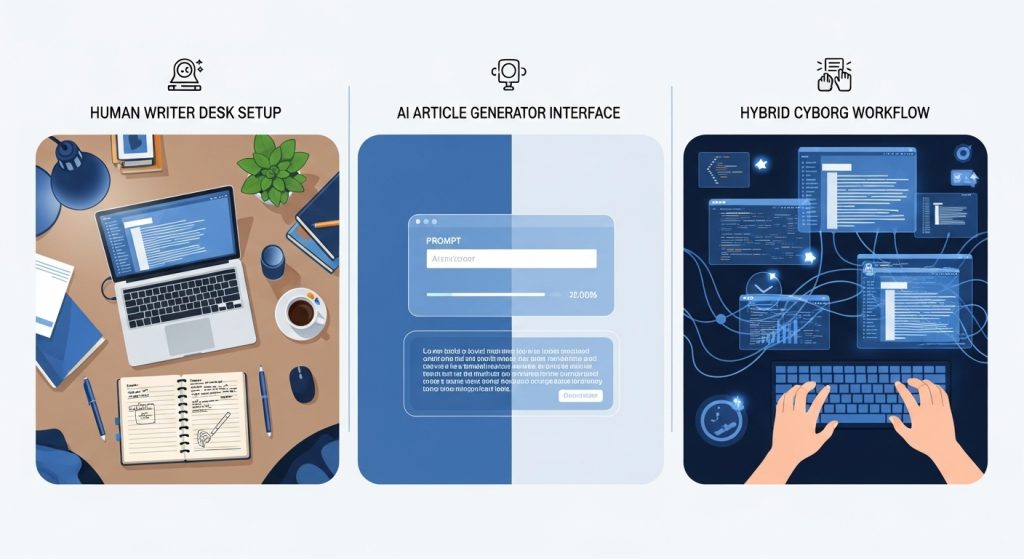
I have spent the last few years deep in the trenches of this revolution, testing virtually every AI article generator with SEO optimisation capability that has hit the market. I’ve ranked sites using 100% human content, 100% AI content (don’t do this—more on that later), and the “Cyborg” hybrid model.
This article isn’t a sales pitch. It’s a field manual. It is a detailed, brutal look at how to actually use these tools to drive traffic without destroying your brand’s reputation or getting slapped by a Google Core Update.
If you are looking for a magic button, stop reading. If you are looking for a workflow to scale your expertise, let’s get to work.

Part 1: The “Vanilla” Trap and The Theory of Average
((AI Article Generator with SEO Optimization))
To master AI writing, you first have to understand its fundamental flaw. I call it the “Vanilla Trap.”
Large Language Models (LLMs)—the brains behind these generators—are predictive engines. They work by analysing the vast ocean of text on the internet and predicting the most likely next word in a sequence. They are consensus machines.
If you ask an AI to write an article about “how to lose weight,” it will scour its training data for the most common advice. It will tell you to eat less, exercise more, drink water, and sleep well.
Is that information wrong? No.
Is it helpful? Technically, yes.
Will it rank? Absolutely not.
Why? Because it is the average of the internet. It is vanilla. Google’s modern algorithms, specifically the “Helpful Content System,” are designed to hunt for “Information Gain.” They want something new—a unique angle, a fresh dataset, a contrarian opinion.
When you use an AI article generator with SEO optimisation features, the tool is often fighting against its own nature. It wants to give you the safe, average answer. Your job, as the human operator, is to force it off the beaten path.
The SEO Disconnect
Many people assume that “SEO Optimisation” in these tools means “Keyword Stuffing.” They think that if the AI sprinkles the phrase “best running shoes” into the text 15 times, they win.
That is 2010 SEO. Today, Semantic SEO is the name of the game.
When I evaluate a generator, I’m not looking at keyword density. I’m looking for Topical Authority and Entity Recognition. Does the AI understand that “Apple” is a fruit in a recipe context but a technology giant in a stock market context?
Most low-end tools fail here. They insert keywords. The high-end workflows—the ones I use—rely on connecting concepts. If I’m writing about “Home Coffee Brewing,” the AI needs to naturally discuss “extraction times,” “grind consistency,” “burr grinders vs. blade grinders,” and “water temperature” without me explicitly forcing every single term.
Part 2: The Pre-Game – Strategy Before Generation
This is where 90% of content creators fail. They open the software, type a headline, and hit “Generate.”
This is suicide for your rankings.
Before I ever let an AI write a single word, I spend about 30 minutes on strategy. The AI is the builder; I am the architect. You cannot expect the builder to design the house.
1. The SERP Analysis
I look at the top 10 results for my target keyword. What is missing?
- Are they all walls of text? (Opportunity: Use AI to generate tables and bullet points).
- Are they all written for experts? (Opportunity: Instruct the AI to write for a beginner audience).
- Are they outdated? (Opportunity: Feed the AI with the current 2026 stats).
2. Developing the Content Brief
A good AI article generator lets you enter a detailed brief or outline. Never let the AI generate the outline blindly.
I build my outlines based on User Intent.
If the keyword is “CRM software pricing,” the user wants numbers, comparison tables, and warnings about hidden fees. They do not want a 500-word intro on “What is a CRM?”
I manually structure the H2S and H3S. I tell the AI specifically:
- Section 1: Direct answer to the pricing question.
- Section 2: Comparison table of the top 3 competitors.
- Section 3: Analysis of hidden costs.
By controlling the skeleton, I ensure the AI puts the meat in the right places.
3. Clustering
I never write one article in isolation. I use AI to help me map out a “Topic Cluster.” If I’m writing the pillar page on “SEO Marketing,” I’m also planning 10 supporting articles on “backlinking,” “on-page technicals,” “local SEO,” etc.
This signals to Google that you are an authority, not just a lucky guesser.
Part 3: The Drafting Phase – Managing the Machine
Now we get to the actual generation. You’ve set up your keywords, you’ve built your outline, and you press the button.
The output appears. It looks clean. The grammar is impeccable. The structure is logical.
Do not publish it.
I treat the raw AI output as a “Rough Draft Zero.” It is wet clay. It has shape, but no detail.
The Tone Check
AI defaults to a tone I describe as “enthusiastic corporate HR manager.” It loves words like “unleash,” “unlock,” “elevate,” “landscape,” and “revolutionary.” It uses transition phrases like “In conclusion,” or “Moreover,” far too often.
It reads like a robot trying to sound human.
My first pass is always a “De-Fluffing” edit.
- AI: “In the rapidly evolving landscape of digital marketing, it is crucial to leverage the power of social media to elevate your brand awareness.”
- My Edit: “Social media moves fast. If you don’t use it to build your brand, you’ll get left behind.”
See the difference? One is filler; the other is communication.
The “Hallucination” Audit
This is the most dangerous part of using an AI article generator with SEO optimisation. The AI will lie to you. It doesn’t know it’s lying; it’s just predicting words that sound plausible.
I once generated an article about “Medical Malpractice Laws in Texas.” The AI cited a specific statute code. When I double-checked it, that code didn’t exist. It looked real—it had the proper formatting—but it was a complete fabrication.
If I had published that, my client could have been sued, or at the very least, lost all credibility.
Rule: If the AI includes a fact, a date, a statistic, or a quote, you must verify it manually. No exceptions.
Part 4: Injecting EEAT (Experience, Expertise, Authority, Trust)
Google’s Quality Rater Guidelines emphasise EEAT. This is the one thing AI cannot generate.
AI has no life experience. It has never felt the sun on its face, never been frustrated by a software bug, and never tasted a bad cup of coffee.
To rank in the modern era, you must inject humanity into the AI draft.
1. First-Person Narratives
I always go into the introduction and add a personal hook.
- Instead of: ” Hiking is a popular activity that requires good boots.”
- I write: “I learned the hard way on the Pacific Crest Trail that a bad pair of boots can ruin your trip before you reach the first mile marker.”
2. Proprietary Images and Data
AI generators can sometimes create images, but they often look uncanny or weird. I prefer to use real screenshots, photos I’ve taken, or graphs I’ve made from real data.
If the article is about software, I take screenshots of the dashboard. If it’s about gardening, I use photos of my own plants. This visual proof screams “Real Human” to both Google and the reader.
3. Contrarian Opinions
AI plays it safe. Humans have opinions.
If the AI writes, “Email marketing is great for everyone,” I might edit it to say, “Actually, if you’re targeting Gen Z, email marketing might be a waste of budget compared to TikTok. Here is why…”
Taking a stance builds trust. It shows you have enough expertise to disagree with the consensus.
Part 5: The Technical Optimisation (The “Green Score” Fallacy)
Most modern AI writing tools come with a sidebar that scores your content from 0 to 100 based on keyword usage.
I see so many writers obsess over hitting “100.” They turn their article into a garbled mess just to fit in the keyword “best plumbing services near me” three times.
Don’t chase the score. Chase the readability.
I use these scores as a directional compass, not a rulebook.
- If the tool says I’m missing the term “sediment buildup” in an article about water heaters, that’s a good reminder. I probably forgot to cover that topic.
- If the tool tells me to use “water heater repair cheap” 12 times, I ignore it. That is keyword stuffing, and it triggers spam filters.
Internal Linking
A significant part of SEO is how your pages interact with each other. AI generators often fail at this. They treat the article as an island.
I manually weave in links to my other articles.
- “We mentioned keyword research earlier (link to my guide on keyword research), but let’s dive deeper into…”
This passes “link juice” around your site and keeps users on the page longer.
Part 6: Ethical Considerations and The “Generic Content” Flood
We have to talk about the ethics of this. The internet is currently being flooded with low-quality, AI-generated spam.
I have seen websites go from 0 to 10,000 pages in a month using automated AI loops. For a few weeks, traffic spikes. Then, Google releases a Core Update, and the site goes to zero. It is a pump-and-dump scheme.
The Ethical Approach:
Use AI to bypass the drudgery, not the thinking.
- It is ethical to use AI to organise your thoughts.
- It is ethical to use AI to summarise complex data.
- It is ethical to use AI to fix your grammar.
It is unethical (and bad business) to churn out 500 articles you haven’t read, filling the internet with noise to sell ad space.
Furthermore, there is the issue of plagiarism. While AI text is technically unique, it is derived from existing content. I always run my final drafts through a plagiarism checker (like Copyscape or Originality.ai). It is rare for AI to copy word-for-word, but it does happen, especially in definitions and legal text.
Part 7: Real-World Case Study
Let me walk you through a recent project to show you the difference between “Lazy AI” and “Smart AI.”
The Client: A boutique coffee roaster.
The Topic: “Arabica vs. Robusta Coffee Beans.”
Attempt 1: Lazy AI (The Wrong Way)
- Prompt: “Write an SEO article about Arabica vs Robusta.”
- Result: A generic 800-word article. It said Arabica tastes better and Robusta has more caffeine. It used the word “delightful” seven times.
- SEO Result: Not ranked in the top 100.
Attempt 2: The “Cyborg” Method (The Right Way)
- Step 1: I researched the keyword. I saw people were asking about specific acidity levels and growing altitudes.
- Step 2: I fed the AI a detailed brief requesting a comparison table of acidity, caffeine, sugar, and lipid content.
- Step 3: The AI wrote the draft.
- Step 4 (The Human Polish): I added a section about a specific Robusta bean from Vietnam that defies the “bad taste” stereotype, based on my own tasting notes. I debunked a myth the AI included about Robusta being “only for instant coffee.” I adjusted the tone from “academic” to “barista conversation.”
- Step 5: I optimised the headers for “Featured Snippets” (Quick answers Google loves).
- SEO Result: Ranked #3 in two weeks.
The difference wasn’t the tool. It was the operator.
Part 8: The Future of Search (SGE and AI Overviews)
We are standing at a precipice. Google is rolling out AI Overviews (formerly SGE), where the search engine answers the question directly at the top of the page.
If your content is just generic information, Google will steal it, summarise it, and no one will click your link.
To survive in an SGE world, your content needs to be “un-summarizable.”
- Be Opinionated: AI won’t take a hard stance. You should.
- Be Narrative: People read stories. AI summarises facts.
- Be Community-Driven: content that includes quotes from real community members or forums is highly valuable.
An AI article generator with SEO optimisation is a tool for the creation phase. Still, the strategy phase must focus on building a brand that people want to visit directly, not just stumble upon via search.

Part 9: Selecting Your Toolkit
I won’t name-drop specific software because they change every week, and what is best today might be obsolete next month. However, when you are shopping for a tool, look for these features:
- NLP (Natural Language Processing) Integration: Does it analyse the top 20 results and suggest semantic keywords?
- Live Web Access: Can the AI browse the live internet to get current facts, or is it stuck with training data from 2021?
- Brand Voice Customisation: Can you upload samples of your own writing so the AI learns to mimic your style? This is crucial for consistency.
- Citation Capabilities: Does it attempt to cite sources? (Always verify them, but it helps the workflow.
Avoid tools that promise “One-Click SEO.” There is no such thing. If it takes one click for you, it takes one click for your 10,000 competitors. You cannot build a competitive advantage on a button that everyone has access to.
Part 10: The Hidden Cost of “Content Velocity”
We need to talk about a metric that has become a vanity trap in the SEO world: Content Velocity. This is the rate at which you publish new pages.
When AI article generators first hit the mainstream, SEO agencies went wild. I saw competitors ramping up from 4 articles a month to 400. The logic was simple: “If 10 articles bring me 1,000 visitors, 1,000 articles will bring me 100,000 visitors.”
I watched this play out in real time on a project I consulted on in the finance niche. They fired their freelance writers and replaced them with two junior editors running AI scripts 24/7. For three months, the graph looked like a hockey stick. Traffic exploded. They were capturing long-tail keywords they never had time for before.
Then, the “Crawl Budget” reality hit.
Google doesn’t have infinite resources. It allocates a certain amount of time (crawl budget) to scan your site. When you flood your site with thousands of mediocre AI pages, Google’s bots get bogged down. They spend all their time indexing low-value content and miss updates to your high-value “money pages.”
The result? Their rankings for their core services dropped. They were winning the battle for “what is a Roth IRA”, but losing the war for “best financial advisor in Chicago.”
The Lesson: Use AI to maintain a steady, healthy heartbeat of content, not to induce tachycardia. Quality control bottlenecks are actually good. If you can’t manually review it, don’t publish it.
Part 11: Adapting to “Zero-Click” Searches
One trend that keeps me up at night—and should concern you too—is the rise of the “Zero-Click” search.
You’ve seen this. You search “how many ounces in a cup,” and Google tells you “8” right at the top. You never click a website. AI generators are accelerating this by making it easier for search engines to extract simple answers.
So, how do you use an AI article generator with SEO optimisation to fight this?
You have to pivot your content strategy toward “Deep Dives.”
Straightforward Q&A content is dead. If an AI can answer your headline in one sentence, you have already lost. I now use AI to help me structure “Ultimate Guides” and “Case Studies.”
Instead of generating an article on “How to fix a leaky faucet,” I create a framework for “Troubleshooting 10 Common Faucet Brands: A Visual Guide.”
I use the AI to:
- Identify the 10 most popular faucet brands.
- List the common unique defects for each.
- Draft the technical explanations for the fix.
Then, I (the human) add the nuance: “Note: Moen cartridges are notoriously stiff; don’t force it or you’ll crack the housing.”
That little nugget of wisdom prevents the user from clicking the back button. It keeps them on the page. It signals to Google that this isn’t just a definition; it’s a solution.
Conclusion: The Human Element Remains King
We are in a golden age of content creation. The barrier to entry has been lowered to the floor. Anyone can generate text.
But because anyone can generate text, the value of average text has plummeted to zero.
The winners in this new era won’t be the ones who refuse to use AI. They will be the ones who use an AI article generator with SEO optimisation as a force multiplier for their own creativity.
Think of it like a carpenter using a power drill instead of a hand screwdriver. The power drill is faster. It’s more efficient. But it doesn’t know how to build a cabinet. You still need the craftsman’s eye to measure the wood, design the joint, and sand the finish until it’s smooth.
My advice? Embrace the tools. Learn the prompts. Master the optimisation. But never, ever forget that at the other end of that screen is a human being looking for connection, truth, and insight. If you can give them that, the algorithms will follow.